

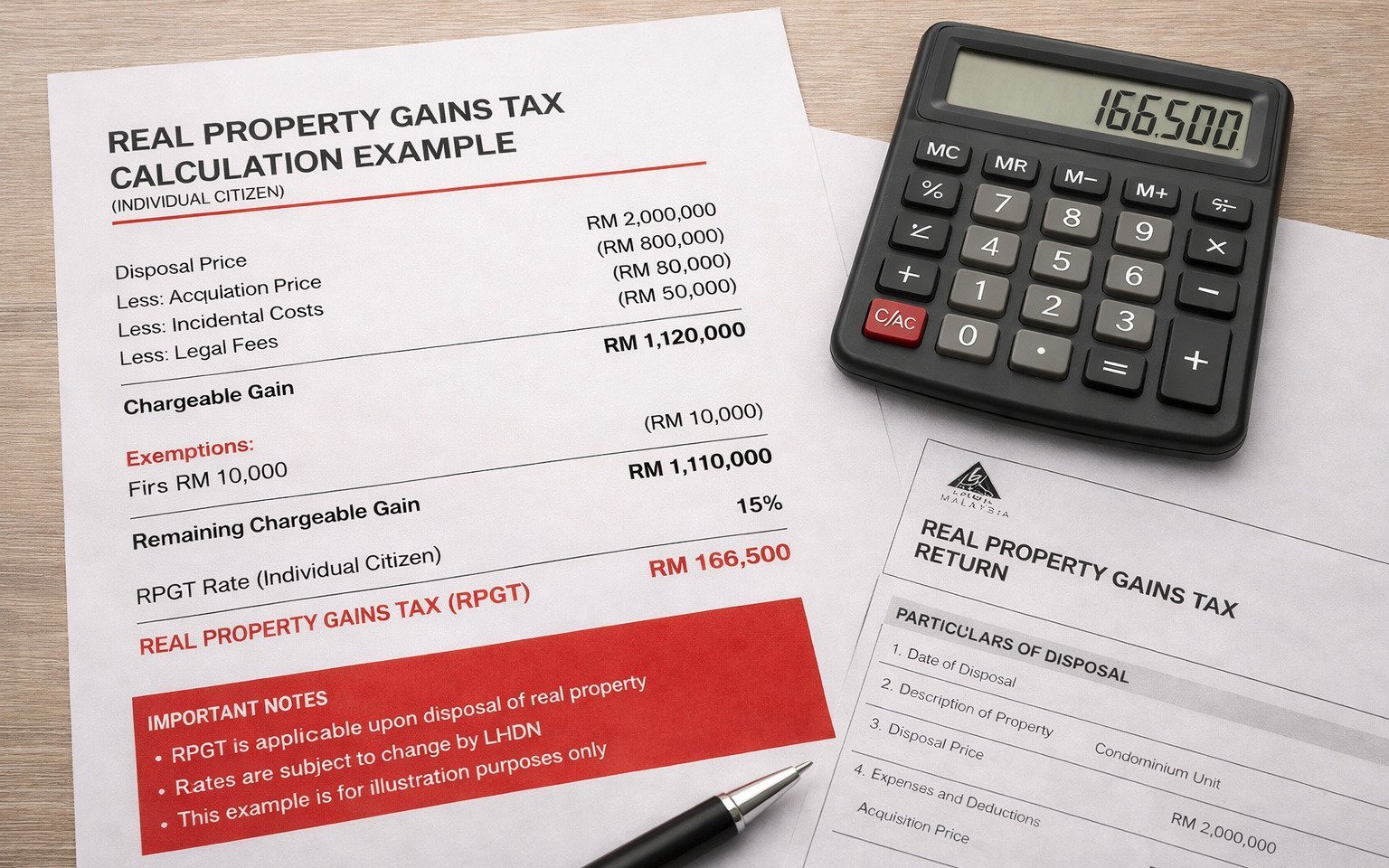
What Is RPGT?
Real Property Gains Tax (RPGT) is a tax on the gain you make when you sell property in Malaysia, not on the sale price. It's collected by the Inland Revenue Board (LHDN) under the Real Property Gains Tax Act 1976. It applies to individuals, companies and trusts, and also to shares in a real property company (broadly, a company whose assets are mostly property).
How much you pay depends on two things: who you are (a Malaysian, a company, or a foreigner) and how long you've owned the property.
What Are the RPGT Rates in 2026?
These are LHDN's current rates (Schedule 5 of the Act), by how many years you've held the property:
| When you sell | Malaysian citizens and PRs | Malaysian companies and trusts | Foreigners (non-citizen, non-PR) and foreign companies |
|---|---|---|---|
| Within 3 years | 30% | 30% | 30% |
| In the 4th year | 20% | 20% | 30% |
| In the 5th year | 15% | 15% | 30% |
| 6th year onwards | 0% | 10% | 10% |
So a Malaysian who holds for more than five years pays no RPGT, while a foreign owner pays 10% of the gain however long they hold. LHDN calls these groups Part I, Part II and Part III.
How Is the Gain Worked Out?
Your gain is the sale price minus what you paid, minus the costs of buying, improving and selling. Costs you can generally deduct include legal fees, stamp duty, agents' commission, and renovations that add to the property's value. Routine maintenance and repairs don't count.
Individuals can also usually deduct an exemption of RM10,000 or 10% of the chargeable gain, whichever is greater.
A worked example (Malaysian seller): you bought for RM800,000, spent RM50,000 on eligible costs, and sell for RM1,200,000 in the 4th year.
| Step | Amount |
|---|---|
| Gain: RM1,200,000 − RM800,000 − RM50,000 | RM350,000 |
| Less exemption (10% of RM350,000, as that's more than RM10,000) | −RM35,000 |
| Chargeable gain | RM315,000 |
| RPGT at 20% (4th year) | RM63,000 |
Sell the same home in the 6th year and a Malaysian citizen pays nothing. A foreign seller would pay 30% within five years and 10% from the sixth year on the chargeable gain. These are illustrations; your lawyer or tax agent will confirm your actual figures.
What Is the 3% or 7% the Buyer Holds Back?
When you sell, the buyer usually holds back part of the price from the sale proceeds and pays it to LHDN within 60 days. It's a deposit towards your RPGT, not the tax itself. The buyer keeps back the lower of all the cash paid or:
| Seller | Amount held back |
|---|---|
| Malaysian citizen or PR | 3% of the price |
| Malaysian company | 5% if sold within 3 years; 3% from the 4th year |
| Foreigner (non-citizen, non-PR) or foreign company | 7% of the price |
If your actual RPGT is lower, you can claim the difference back; if it's higher, you pay the balance. From 2026 the buyer may instead hold back your deemed-assessed tax, if you notify them in time, which helps when the real tax is small or zero. It doesn't apply to disposals without money changing hands.
What Do You Need to File, and When?
Both sides file within 60 days of the disposal date, which is usually the date the Sale and Purchase Agreement is signed:
- The seller files CKHT 1A (individuals) or CKHT 1B (companies and others).
- The buyer files CKHT 2A, and pays the amount held back to LHDN.
Returns are generally filed online through LHDN's MyTax portal, and your lawyer usually helps. The filing is required even if no tax ends up being due.
What Happens If You File Late or Get It Wrong?
According to LHDN, failing to file can lead to a penalty of up to three times the tax (section 29(3)), and an incorrect return up to 100% of the tax undercharged (section 30(2)). A buyer who doesn't pay over the amount held back faces a 10% increase on the unpaid sum. Filing on time and keeping your receipts avoids all of this.
Are There Exemptions?
- The RM10,000 or 10% exemption for individuals, shown in the example above.
- Your own home, once in a lifetime: a Malaysian citizen or PR can generally claim a one-off exemption on the sale of one private residence.
- Holding period: Malaysian citizens and PRs pay 0% from the 6th year.
Whether you qualify depends on your details, so check with your lawyer or a tax agent before you sell.
What Does RPGT Mean for Foreign Buyers?
If you're buying in Kuala Lumpur as a foreigner, plan your holding period with RPGT in mind: 30% of the gain if you sell within five years, 10% after that. When you sell, the buyer will usually hold back 7% of the price from your sale proceeds for LHDN, and you can claim back any excess. For the other costs of buying and owning, see how much cash a foreigner needs and our stamp duty guide.
FAQ
30% of the gain if a foreigner (non-citizen, non-PR) sells within five years, and 10% from the sixth year onwards, according to LHDN's current rates.
No. Malaysian citizens and permanent residents pay 0% RPGT when they sell in the 6th year or later. Within three years it's 30%, then 20% in the 4th year and 15% in the 5th.
The buyer holds back part of the price from the sale proceeds and pays it to LHDN within 60 days as a deposit towards the seller's RPGT: 3% if the seller is a Malaysian citizen or PR, and 7% if the seller is a foreigner. Any excess over the actual tax can be claimed back.
On the gain: the sale price minus the purchase price and allowable costs such as legal fees, stamp duty, agents' commission and value-adding renovations. Individuals can usually deduct RM10,000 or 10% of the gain, whichever is greater, before the rate for their holding period is applied.
60 days from the date of disposal, usually the date the Sale and Purchase Agreement is signed. The seller files CKHT 1A or 1B, and the buyer files CKHT 2A.
A Malaysian citizen or PR can generally claim a once-in-a-lifetime exemption on the sale of one private residence. Check with your lawyer or tax agent whether it's worth using on a particular sale.
Updated September 2026. Rules, bank policies and fees change, and every purchase is different. This article is general information, not legal or tax advice, so please check the details with your lawyer and bank before you sign.