

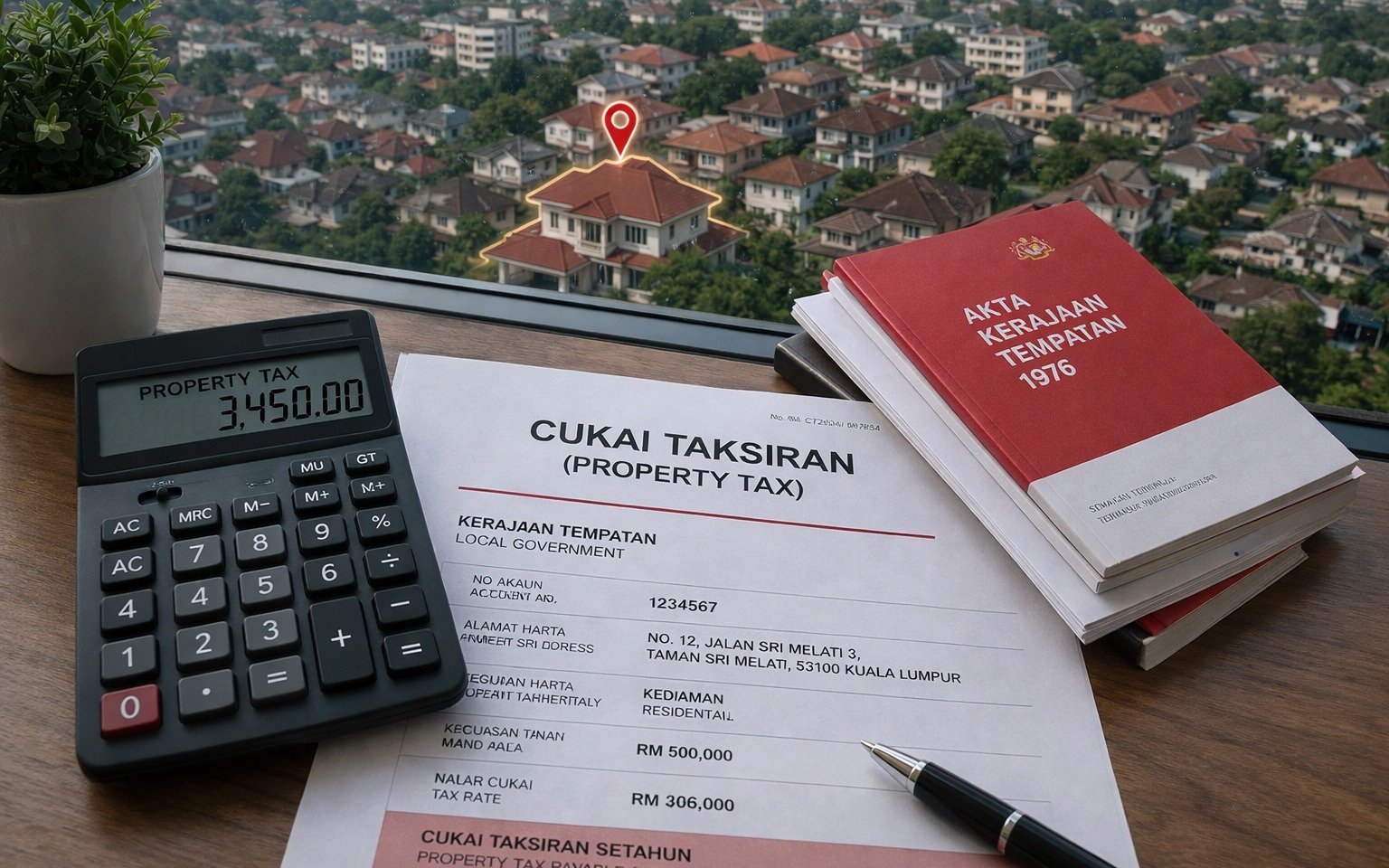
What Is Property Tax in Malaysia?
Property tax in Malaysia means two yearly bills: assessment tax (cukai pintu) to your local council, and quit rent (cukai tanah) to the state land office. There's no single national "property tax"; here's how the two compare:
| Assessment tax | Quit rent | |
|---|---|---|
| Also called | Cukai taksiran, or cukai pintu (“door tax”) | Cukai tanah; for a condo unit with its own strata title, parcel rent (cukai petak) |
| Charged by | Your local council, e.g. Kuala Lumpur City Hall (DBKL) | The state land office (Pejabat Tanah dan Galian, PTG, or the district land office) |
| Based on | Your property's annual value (its estimated yearly rent) × the council's rate | The land or parcel; billed by the state land office |
| How often | Yearly, paid in two halves | Once a year |
Neither one is collected by the Inland Revenue Board (LHDN). LHDN deals with income tax, including tax on rental income, and with Real Property Gains Tax when you sell. So income-tax reliefs don't reduce either of these bills.
In one line: assessment tax goes to the local council, quit rent goes to the land office, and both are modest, predictable yearly costs.
How Is Assessment Tax Calculated?
Assessment tax is your property's annual value multiplied by the council's rate. Councils charge it under section 127 of the Local Government Act 1976.
- Annual value isn't a share of what you paid for the home. For a building, DBKL defines it as the estimated gross annual rent the property could reasonably earn. For vacant land, it's 10% of the land's market value.
- The rate is a percentage set by the council, depending on the property type and location. In Kuala Lumpur, DBKL's rates range from 1% to 10%, and its own example bill for a home uses 4%.
DBKL's worked example: an annual value of RM13,200 × 4% = RM528 a year, paid as RM264 each half-year.
If you disagree with your annual value, you can send DBKL a written objection at least 10 days before its hearing.
When Is Assessment Tax Due in Kuala Lumpur?
DBKL bills twice a year. Pay the first half by 28 February and the second half by 31 August.
If a half goes unpaid, DBKL can add a late notice charge (Form E) under section 147 of the Local Government Act. If the bill is still unpaid 15 days after that notice, the council can issue a warrant of attachment (Form F) under section 148, so it's worth paying on time.
You can pay through DBKL's Pay@KL app and its other listed channels. Other councils have their own deadlines and payment portals, so check your bill.
A vacant home isn't exempt, though DBKL lets owners of vacant properties apply for a vacancy allowance.
What Is Quit Rent, and Who Collects It?
Quit rent is a yearly charge on land, billed and collected by the state land office, not the local council. For a condo unit that has its own strata title, it's called parcel rent (cukai petak). The land office bills it in the name of the owner registered on the strata title, and you pay it at the land office where the property is located, or through other channels your state offers.
In Kuala Lumpur, that's the Federal Territories land office (Pejabat Pengarah Tanah dan Galian Wilayah Persekutuan). Pay it by the deadline on your bill; in many Peninsular states it's commonly 31 May, but always go by the date printed on your bill.
How Much Should You Budget?
For an RM1 million condo in Kuala Lumpur, budget roughly RM1,000–2,000 a year in assessment tax and RM50–200 in quit rent. RM1 million is Kuala Lumpur's minimum price for foreign buyers, used here as an example, not the price of any particular project.
| Bill | Paid to | Estimate |
|---|---|---|
| Assessment tax | DBKL, in two halves | About RM1,000–2,000 a year |
| Quit rent (parcel rent) | The Federal Territories land office, yearly | About RM50–200 a year |
These are estimates only. Every unit's annual value is different, so the actual bills are what count. On top of these, a condo has its monthly maintenance fee and sinking fund, paid to the building's management body. Our guide to how much cash you'll need puts all of this together.
Do Foreigners Pay More Property Tax?
No. Assessment tax and quit rent are charged the same way whoever owns the property. Where foreign buyers do pay more is stamp duty when they buy (a flat 8%) and Real Property Gains Tax when they sell.
Who Pays If the Property Is Rented Out?
The bills are addressed to the owner, and the owner is responsible for paying them. Whether any of the cost is passed on to a tenant is a matter for your tenancy agreement.
FAQ
Cukai pintu is assessment tax (cukai taksiran): charged by your local council, such as DBKL, on the property's annual value and paid in two halves each year. Cukai tanah is quit rent (parcel rent, or cukai petak, for a strata unit): a yearly charge on the land, billed by and paid to the state land office.
Annual value multiplied by the council's rate. For a building, annual value is the estimated gross annual rent it could reasonably earn, not a percentage of the price you paid. In Kuala Lumpur, DBKL's rates range from 1% to 10% depending on property type and location; its example for a home uses 4%.
Twice a year: the first half by 28 February and the second half by 31 August. If a half goes unpaid, DBKL can add a late notice charge under section 147 of the Local Government Act 1976.
The Federal Territories land office (Pejabat Pengarah Tanah dan Galian Wilayah Persekutuan), not DBKL and not LHDN. For a condo with its own strata title, it's billed as parcel rent in the registered owner's name.
No. Assessment tax goes to the local council and quit rent to the state land office. LHDN handles income tax, including tax on rental income, and Real Property Gains Tax when you sell.
No. Assessment tax and quit rent are charged the same way for local and foreign owners. Foreign buyers pay more in stamp duty when buying (a flat 8%) and in Real Property Gains Tax when selling.
As a rough estimate, about RM1,000 to RM2,000 a year in assessment tax and about RM50 to RM200 a year in quit rent. Every unit's annual value is different, so the actual bills are what count.
Updated September 2026. Rules, bank policies and fees change, and every purchase is different. This article is general information, not legal or tax advice, so please check the details with your lawyer and bank before you sign.