

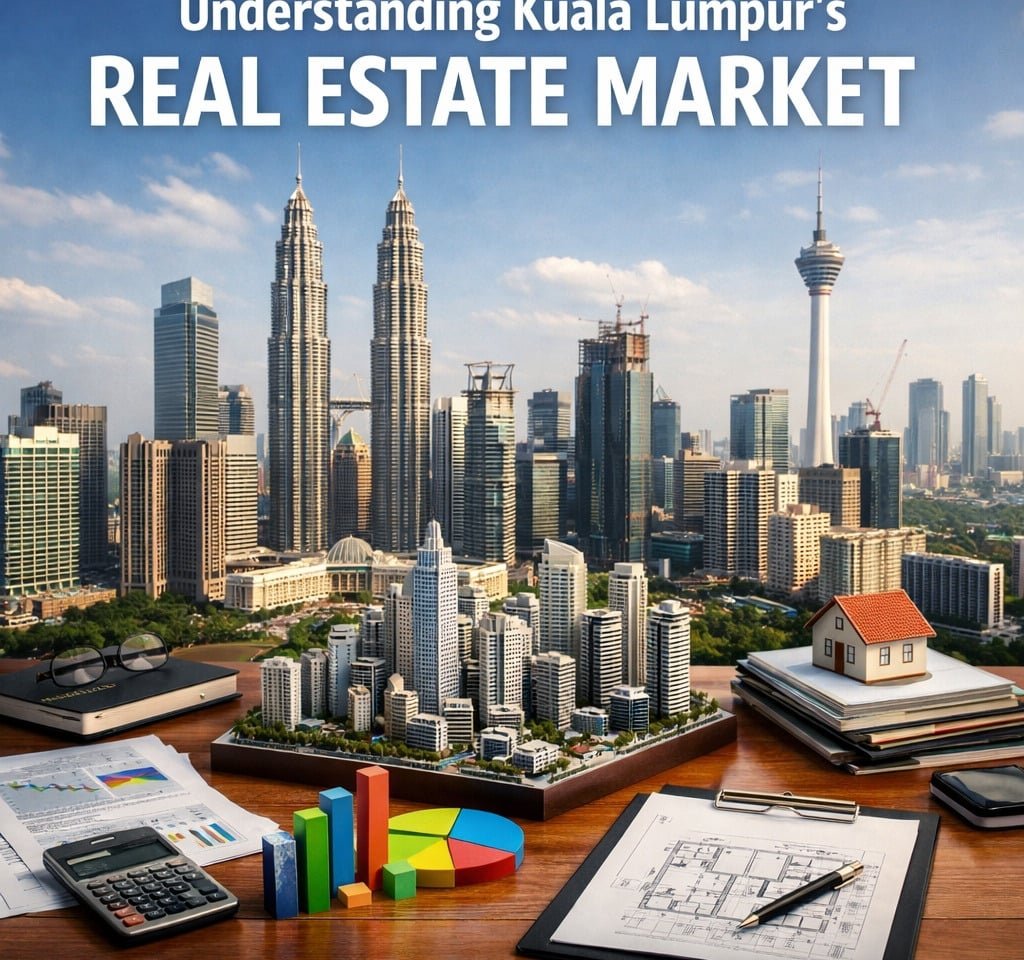
How Does the Kuala Lumpur Property Market Work?
Think of Kuala Lumpur as dozens of small markets rather than one. Two condos a few kilometres apart can behave very differently, and the address, especially how close it is to an MRT or LRT station, often matters more than anything else on the listing.
For official price data, the National Property Information Centre (NAPIC, part of the Valuation and Property Services Department) publishes Malaysia's house price index and transaction reports. It's the best place to check how a particular area is actually moving, rather than relying on headlines.
What Types of Property Can You Buy?
| Type | What to know |
|---|---|
| Condos and serviced apartments | The main choice in the city centre. Each unit has its own strata title once issued, and owners share the building's running costs. |
| Landed homes | Terraces, semi-detached homes and bungalows, mostly outside the core. Some states restrict landed purchases by foreigners. |
| Commercial-titled units (SOHO, SOVO) | Small-office units that can also be lived in. Check with your lawyer what a commercial title means for how you use and finance the unit. |
Every property is also either freehold (owned permanently) or leasehold (usually for a fixed term such as 99 years). Always check the year a lease ends.
Where Do Buyers Look in Kuala Lumpur?
These are the areas where most of the projects we follow are located, new launches and completed homes alike, with an example project in each:
| Area | Character | Example project |
|---|---|---|
| KLCC | The city centre, around the Petronas Twin Towers and Suria KLCC | KL360, Armani Hallson KLCC |
| Bukit Bintang | Shopping and entertainment, linked to Pavilion Kuala Lumpur | Pavilion Square |
| TRX | The new financial district around The Exchange TRX | Golden Crown Residence |
| Cochrane | City fringe, next to MyTOWN and IKEA Cheras | Binastra Cochrane |
| Damansara Heights | Established, leafy, around Pavilion Damansara Heights | Imperial Residences, Royal Suites |
| Mont Kiara | A popular expatriate and family neighbourhood | WOLO Mont Kiara |
| Bangsar | Established and central, one LRT stop from KL Sentral | Parkside Residences |
| Cheras (Maluri) | City fringe, beside Sunway Velocity Mall | Alderwood Residence |
| Jalan Ampang (Embassy Row) | Established embassy enclave near Gleneagles Hospital and international schools (see our Ampang Hilir guide) | Cappella Embassy (completed 2022, formerly D’Rapport Residences), Novo Reserve (completed 2022, opposite Gleneagles), The Ash (U-Thant) |
For a side-by-side view of tenure, completion dates, sizes and MRT access, see our comparison of ten KL new launches.
Should You Buy a New Launch or a Subsale?
A new launch is bought from the developer before or during construction. You usually pay 10% at signing, then in stages as the building goes up. Most developers cover the buyer's legal fees, and for foreign buyers the 8% stamp duty is due at handover. The trade-off is waiting, often several years, for completion.
A subsale is a completed home bought from its current owner. You can see exactly what you're getting and move in or rent it out sooner. You usually pay a 10% deposit at signing and the balance within about three months (for foreigners, generally counted from the state's approval), and you pay your own legal fees.
Can Foreigners Buy Property in Kuala Lumpur?
Yes. The main rules:
- The minimum price for foreign buyers in Kuala Lumpur is RM1 million, and each purchase needs the state's approval, which your lawyer applies for.
- You don't need an MM2H visa to buy, though owning a home doesn't give you the right to live here.
- Stamp duty on the transfer is a flat 8% for foreign buyers.
- Banks usually lend foreigners up to 80%, depending on the bank and your income documents.
Our guide to the foreign-buyer rules covers each of these in detail, and this guide explains what you can do from abroad.
How Much Does Buying and Owning Cost?
With an 80% loan, a foreign buyer should plan on about 30% of the price in cash across the whole purchase: the 20% down payment, the 8% stamp duty and about 2% in legal fees and charges. After you buy, a condo comes with a monthly maintenance fee and sinking fund, plus two small yearly bills: assessment tax to the city council and quit rent to the land office.
See how much cash a foreigner needs, our stamp duty guide and our property tax guide for the details.
What Tax Do You Pay When You Sell?
Real Property Gains Tax (RPGT) is charged on the gain. Malaysian citizens and PRs pay 30% within three years, 20% in the 4th year, 15% in the 5th and nothing from the 6th. Foreign owners pay 30% within five years and 10% after that. Our RPGT guide explains the full rules.
Should You Rent or Buy?
It depends mostly on how long you'll stay. Buying carries real upfront costs (stamp duty, legal fees) and, for foreigners, 30% RPGT on any gain within five years, so it tends to make more sense if you're planning for the long term. Renting keeps you flexible while you get to know the city and its neighbourhoods. Many overseas families rent first, then buy once they know which area suits them.
FAQ
Yes. Foreign buyers in Kuala Lumpur must pay at least RM1 million, and each purchase needs the state's approval, which the buyer's lawyer applies for. No MM2H visa is needed to buy.
A flat 8% on the transfer, whatever the price, since 1 January 2026. On a new launch it's due at handover.
Usually up to 80% of the price, depending on the bank and your income documents. Get a loan pre-approval before you commit.
A new launch is bought from the developer and paid in stages during construction; most developers cover the legal fees. A subsale is a completed home bought from its owner; you pay a deposit at signing and the balance within about three months, plus your own legal fees.
The National Property Information Centre (NAPIC), part of the Valuation and Property Services Department (JPPH), publishes Malaysia's house price index and property market reports.
Real Property Gains Tax on the gain: for Malaysian citizens and PRs, 30% within three years, 20% in the 4th year, 15% in the 5th and 0% from the 6th; for foreigners, 30% within five years and 10% after.
Updated September 2026. Rules, bank policies and fees change, and every purchase is different. This article is general information, not legal or tax advice, so please check the details with your lawyer and bank before you sign.